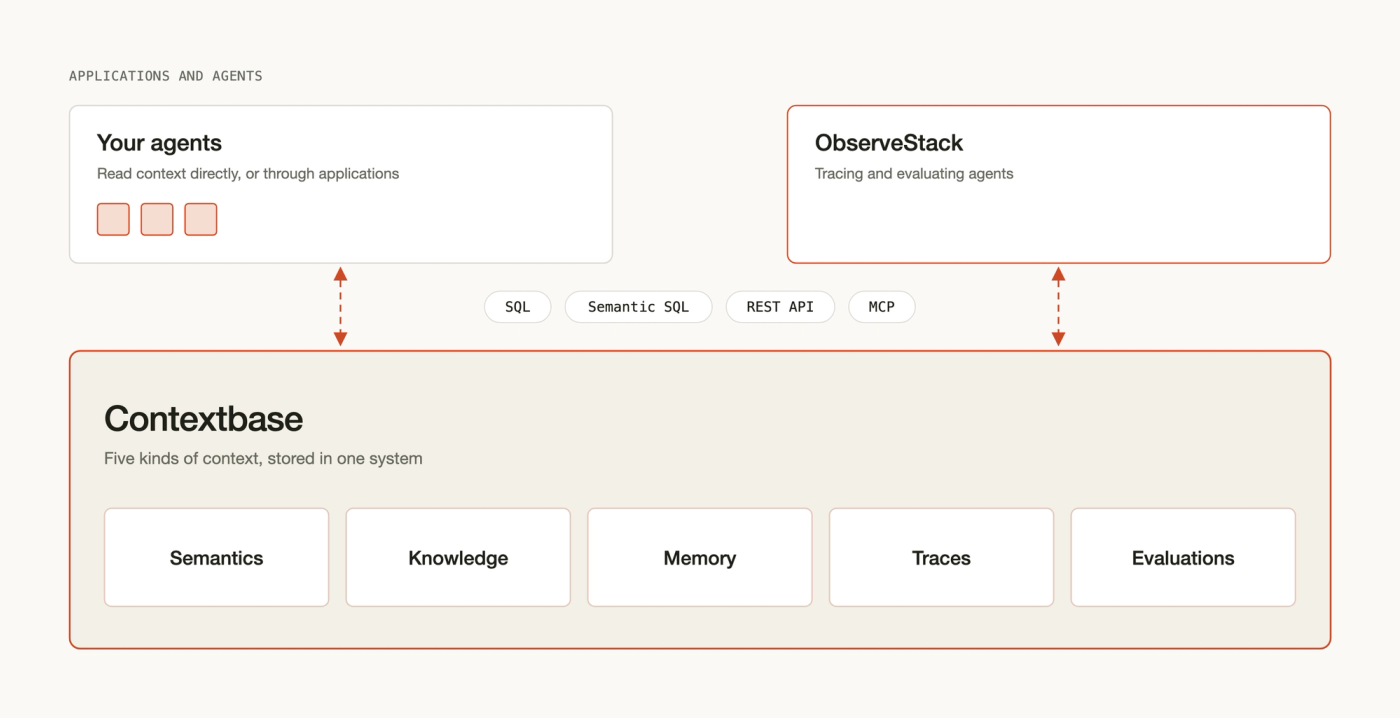
The context infrastructure for AI agents. It stores semantics, knowledge, memory, traces, and evaluations as context in one system, so agents understand, reason, and act better with every run.
Each kind of context lives in a different tool today.
ContextToday’s toolWhere it stops
SemanticsA semantic layer, or definitions in the promptComplex metrics can't be defined, so agents guess what the data means.
KnowledgeRAG and a vector databaseChunked by length; structure and links are lost.
MemoryMemory storesOnly chat history; it can't be combined with traces or business data.
Traces and evalsTrace and eval toolsCut off from business data; analysis means exporting first.
PermissionsOne set per systemNo single policy can be enforced.
What it is
Context infrastructure, run like a database.
Contextbase stores every kind of context an agent needs in one system, and serves it the way a real-time database serves data.
One querySQL, Semantic SQL, search, REST, or MCP.
Real timeSub-second from write to query, with many agents reading at once.
Unified and governedAgents read and write back in one place, under one set of permissions, with versions and audit.
See it work
The agent learns from its own traces.
ShopPilot, a sample analytics agent built on Contextbase, reads its own traces, sees that it repeated the same join, and proposes a semantic view. Nothing is created until a person approves it.
KPIs come from semantic views, and every query is verified before it runs.
run_semantic_sql
02Investigate
Follows the links to the cause
Context search follows a product to its supplier to a notice that never names the product.
context_searchcontext_graph_expand
03Review
Reads its own traces
One SQL query over its traces shows it repeated the same join four times.
trace_query
04Improve
Drafts a view, a person approves
The new view answers in one query and passes an eval 5 of 5. It goes live once a person approves it.
propose_semantic_view
Benchmarks
Accuracy and recall.
The same model answered the same 148 questions three times. Only the context changed.
Raw schema
No added context
31.1%
Docs in the prompt
Documentation pasted into the prompt
87.8%
Semantic views in Contextbase
Definitions the engine runs and checks
94.6%
Execution accuracy · LiveSQLBench (adapted), 148 questions · Claude Opus 5.5
84%
Recall on two-hop questions
Context search (text, vector, and graph) vs. 73% for OpenSearch hybrid search (text and vector) · 2WikiMultiHopQA, recall@10
What it stores
Five kinds of context, one system.
Today each has its own system, its own copy of the data, and its own permissions. In Contextbase they live together, so one query can use them all.
Semantics
What the data means
Semantic views straight on raw data, with no ETL. Compiled once, so the same question gets the same number. Every query is verified, and what can't be proven is refused, with a reason.
Knowledge
What the company knows
Each item is a Context Entity: properties, Markdown sections, whole files, and relationships. Search follows the relationships.
Memory
What earlier runs learned
Distilled from the full trace, not just the chat, and kept next to the traces and business data it came from.
Traces
What agents did and read
Each step of a run, stored as traces and spans and queryable with SQL next to business data. Reads can be pinned to a version. Ingested over OpenTelemetry.
Evaluations
Whether it worked
Scores stored with the traces they judge, so you can query which answers scored low, what they read, and how they relate to business outcomes.
One set of permissions · versions · audit
The context flywheel
Every agent makes the context better for the next one.
Better context makes better agents. Every run writes back traces and evals, and new semantic views and knowledge once a person approves them, which makes the context better. Each new agent starts from all of it.
Launch a support agent next month, and on day one it already knows how your company defines conversion, which supplier is late, and what worked last Black Friday. It doesn't start from zero.
Start with one agent.
Contextbase is in private preview. Start a free trial to request access; we review every request. A good first project is one agent and one domain: semantic views on your tables, one knowledge source, and traces and evals turned on.